Monday, February 6, 2017

UNIT 6 - Performance skills and context

Before we started to work on Shakespeare, our group was given different tasks to complete before getting started on the real work. Tasks included reading the description of the plays, the plays as a whole and viewing the video representations of the plays. Our mentor gave us free hand when choosing the desired play and role, but nevertheless chose it for us in the end. I ended up with Beatrice from "Much ado about nothing", and in order to make a connection with the character I did a bit of research on bits and pieces, including Youtube videos and the simplified language play that I have found online. As soon as I began to understand my character's personality and inner thoughts, I came to realise that she was similar to me. I found her to be outspoken, smart, with an independent side to her whilst still keeping the sensible side hidden in her heart.

We got a few days off on half term, before the group rehearsals started, and that is when I began the process of analysing and understanding the character, creating the internal monologue which I kept in my mind every time I was saying my lines. When I was at home, I rehearsed the role saying the lines out loud in my room, to get used to the role and to learn them. I managed to keep the text and subtext in my mind when the official group rehearsals started. The rehearsals went really well, it took us some time to get used to the Shakespearian language and to know our lines by heart, but we helped each other every time and we never forgot to say the key line so we didn't confuse the others. We worked together as an ensemble, we had a lot of fun with our characters in rehearsals, we helped each other to understand the storyline of the play and the story behind the text, also our teachers helped us with understanding where is our place throughout the play, who we are and what is our purpose in there. They also helped us with building the right energy, they listened to our ideas and proposals when they were directing and also added some of our ideas which built our confidence and helped us  enjoy the piece of theatre. Even if it seemed to be old and boring at the beginning, we made it fun and interesting until the end. I am so happy that I've been a part of this project, I learnt how to love every single role that I receive even if I'm not content with it at first sight. I learnt that it doesn't matter what role you have because if you work hard and put emotion into it, you won't only show the audience but to yourself,as well , the best version of your representation of the character.

As part of the advertising area, we have decided to invite families and friends, some of us even posting about it on social media, which increased the chances of more people attending the performance. The college had also invited a theatre company to see us, in order for us to get that real emotion of being on stage in front of strangers and not only family members or friends. We had two performances, of which one in the afternoon, where all the performing arts classes attended, and one in the evening, where our guests and the theatre company were invited. The college had also provided for the guests programmes of the play, handed to each individual when entering the venue.


Research:

Much Ado About Nothing is a comedy by William Shakespeare thought to have been written in 1598 and 1599, as Shakespeare was approaching the middle of his career. The play was included in the First Folio, published in 1623. Much Ado About Nothing is generally considered one of Shakespeare's best comedies because it combines elements of mistaken identities, love, robust hilarity with more serious meditations on honour, shame, and court politics.
By means of "noting" (which, in Shakespeare's day, sounded similar to "nothing" as in the play's title,[1][2] and which means gossip, rumour, and overhearing), Benedick and Beatrice are tricked into confessing their love for each other, and Claudio is tricked into rejecting Hero at the altar on the erroneous belief that she has been unfaithful. At the end, Benedick and Beatrice join forces to set things right, and the others join in a dance celebrating the marriages of the two couples.

Summary[edit]


A painting of Beatrice by Frank Dicksee, from The Graphic Gallery of Shakespeare's Heroines
At Messina, a messenger brings news that Don Pedro, a prince from Aragon, will return that night from a successful battle, Claudio being among his soldiers. Beatrice, Leonato's niece, asks the messenger about Benedick and makes sarcastic remarks about his ineptitude as a soldier. Leonato explains that "There is a kind of merry war betwixt Signior Benedick and her."[3]
Upon the arrival of the soldiers, Leonato welcomes Don Pedro and invites him to stay for a month, Benedick and Beatrice resume their "merry war," and Pedro's illegitimate brother Don John is introduced. Claudio's feelings for Hero, Leonato's only daughter, are rekindled upon seeing her, and Claudio soon announces to Benedick his intention to court her. Benedick, who openly despises marriage, tries to dissuade his friend but Don Pedro encourages the marriage. Benedick swears that he will never get married. Don Pedro laughs at him and tells him that when he has found the right person he shall get married.
masquerade ball is planned in celebration of the end of the war, giving a disguised Don Pedro the opportunity to woo Hero on Claudio's behalf. Don John uses this situation to get revenge on his brother Don Pedro by telling young Claudio that Don Pedro is wooing Hero for himself. A furious Claudio confronts Don Pedro, but the misunderstanding is quickly resolved and Claudio wins Hero's hand in marriage.
Meanwhile, Benedick disguises himself and dances with Beatrice. Beatrice proceeds to tell this "mystery man" that Benedick is "the prince's jester, a very dull fool." Benedick, enraged by her words, swears he will have revenge. Don Pedro and his men, bored at the prospect of waiting a week for the wedding, harbour a plan to match-make between Benedick and Beatrice. They arrange for Benedick to overhear a conversation in which they declare that Beatrice is madly in love with him but afraid to tell him; that their pride is the main impediment to their courtship. Meanwhile, Hero and her maid Ursula ensure Beatrice overhears them discuss Benedick's undying love for her. The tricks have the desired effect: both Benedick and Beatrice are delighted to think they are the object of unrequited love, and both accordingly resolve to mend their faults and reconcile.
Meanwhile, Don Pedro's brother Don John, the "bastard prince", plots to prevent the wedding, embarrass his brother and wreak misery on Leonato and Claudio. He informs Don Pedro and Claudio that Hero is unfaithful, and arranges for them to see John's associate Borachio enter her bedchamber where he has an amorous liaison (actually with Margaret, Hero's chambermaid). Claudio and Don Pedro are taken in, and Claudio vows to humiliate Hero publicly.

Swooning of Hero in the Church scene by Alfred Elmore
At the wedding the next day, Claudio denounces Hero before the stunned guests and storms off with Don Pedro. Hero faints. Her humiliated father Leonato expresses the wish that she would die. The presiding friar intervenes, believing Hero to be innocent. He suggests the family fake Hero's death in order to extract the truth and Claudio's remorse. Prompted by the day's harrowing events, Benedick and Beatrice confess their love for each other. Beatrice then asks Benedick to slay Claudio as proof of his devotion, since he has slandered her kinswoman. Benedick is horrified and at first, denies her request. Leonato and his brother Antonio blame Claudio for Hero's apparent death and challenge him to a duel. Benedick then does the same.
Luckily, on the night of Don John's treachery, the local Watch apprehended Borachio and his ally Conrade. Despite the comic ineptness of the Watch (headed by constable Dogberry, a master of malapropisms), they have overheard the duo discussing their evil plans. The Watch arrest the villains and eventually obtain a confession, informing Leonato of Hero's innocence. Though Don John has fled the city, a force is sent to capture him. Claudio, stricken with remorse at Hero's supposed death, agrees to her father's demand that he marry Antonio's daughter, "almost the copy of my child that's dead"[3] and carry on the family name.
At the wedding, the bride is revealed to be Hero, still living. Claudio is overjoyed. Beatrice and Benedick, prompted by their friends' interference, finally and publicly confess their love for each other. As the play draws to a close, a messenger arrives with news of Don John's capture – but Benedick proposes to postpone his punishment to another day so that the couples can enjoy their new-found happiness. Don Pedro is lonely because he hasn't found love. Thus Benedick gives him the advice "Get thee a wife."

Sources[edit]

Stories of lovers deceived into believing each other false were common currency in northern Italy in the sixteenth century. Shakespeare's immediate source could have been one of the Novelle ("Tales") by Matteo Bandello of Mantua, dealing with the tribulations of Sir Timbreo and his betrothed Fenicia Lionata in Messina after King Piero's defeat of Charles of Anjou, perhaps through the translation into French by François de Belleforest.[4] Another version featuring lovers Ariodante and Ginevra, with the servant Dalinda impersonating Ginevra on the balcony, appears in Book V of Orlando Furioso by Ludovico Ariosto, published in an English translation in 1591.[5] The character of Benedick too has a counterpart in a commentary upon marriage in Orlando Furioso,[6] but the witty wooing of Beatrice and Benedick is original and very unusual in style and syncopation.[4] One version of the Claudio/Hero plot is told by Edmund Spenser in "The Faerie Queen" (Book II, Canto iv).[7]

Date and text[edit]


The title page from the first quarto edition of Much Adoe About Nothing, printed in 1600.
The earliest printed text states that Much Ado About Nothing was "sundry times publicly acted" prior to 1600 and it is likely that the play made its debut in the autumn or winter of 1598–1599.[8] The earliest recorded performances are two that were given at Court in the winter of 1612–1613, during the festivities preceding the marriage of Princess Elizabeth with Frederick V, Elector Palatine (14 February 1613). The play was published in quarto in 1600 by the stationers Andrew Wise and William Aspley. This was the only edition prior to the First Folio in 1623.

Analysis and criticism[edit]

Style[edit]

The play is one of the few in the Shakespeare canon where the majority of the text is written in prose.[9] The substantial verse sections are used to achieve both courteous decorum, on the one hand, and impulsive energies, on the other.[10]

Setting[edit]

Much Ado About Nothing is set in Messina, a port on the island of Sicily, which is next to the toe of Italy. Sicily was ruled by Aragon at the time the play was set.[11] The action of the play takes place mainly at the home and on the grounds of Leonato's Estate.

Themes and motifs[edit]

Gender roles[edit]


Drawing of Herbert Beerbohm Tree as Benedick and Winifred Emery as Beatrice in a 1905 production. Act II, Scene v: "Kill Claudio".
Benedick and Beatrice quickly became the main interest of the play, to the point where they are today considered the leading roles, even though their relationship is given equal or lesser weight in the script than Claudio and Hero's situation. Charles II even wrote 'Benedick and Beatrice' beside the title of the play in his copy of the Second Folio.[12] The provocative treatment of gender is central to the play and should be considered in its Renaissance context. While this was reflected and emphasised in certain plays of the period, it was also challenged.[13] Amussen[14] notes that the destabilising of traditional gender clichés appears to have inflamed anxieties about the erosion of social order. It seems that comic drama could be a means of calming such anxieties. Ironically, we can see through the play's popularity that this only increased people's interest in such behaviour. Benedick wittily gives voice to male anxieties about women's "sharp tongues and proneness to sexual lightness".[13] In the patriarchal society of the play, the men's loyalties were governed by conventional codes of honour and camaraderie and a sense of superiority to women.[13] Assumptions that women are by nature prone to inconstancy are shown in the repeated jokes on cuckoldry and partly explain Claudio's readiness to believe the slur against Hero. This stereotype is turned on its head in Balthasar's song, which shows men to be the deceitful and inconstant sex that women must suffer.

Infidelity[edit]

theme in Shakespeare is cuckoldry or the infidelity of a wife. Several of the characters seem to be obsessed by the idea that a man has no way to know if his wife is faithful and therefore women can take full advantage of that fact. Don John plays upon Claudio's pride and fear of cuckoldry, which leads to the disastrous first wedding. Many of the males easily believe that Hero is impure and even her father readily condemns her with very little proof. This motif runs through the play, often in references to horns, a symbol of cuckoldry.
In contrast, Balthasar's song "Sigh No More" tells women to accept men's infidelity and continue to live joyfully. Some interpretations say that Balthasar sings poorly, undercutting the message. This is supported by Benedick's cynical comments about the song, where he compares it to a howling dog. However, in the 1993 Branagh film Balthasar sings beautifully, the song is also given a prominent role in both the opening and finale and the message appears to be embraced by the women in the film.[15]

Deception[edit]

In Much Ado About Nothing, there are many examples of deception and self-deception. The games and tricks played on people often have the best intentions—to make people fall in love, to help someone get what they want, or to make someone realise their mistake. However, not all are meant well, such as when Don John convinces Claudio that Don Pedro wants Hero for himself, or when Borachio meets 'Hero' (who is actually Margaret, pretending to be Hero) in Hero's bedroom window.

Masks and mistaken identity[edit]

People are constantly pretending to be others or being mistaken for other people. An example of this is Margaret who is mistaken for Hero, which leads to Hero's public disgrace at her wedding with Claudio. However, during a masked ball in which everyone must wear a mask, Beatrice rants about Benedick to a masked man who turns out to be Benedick himself but Beatrice is unaware of this at the time. During the same celebration, Don Pedro, masked, pretends to be Claudio and courts Hero for him. After Hero is announced "dead," Leonato orders Claudio to marry his "niece," who is actually Hero in disguise.

Noting[edit]


A watercolor by John Sutcliffe: Beatrice overhears Hero and Ursula.
Another motif is the play on the words nothing and noting, which in Shakespeare's day were near-homophones.[16] Taken literally, the title implies that a great fuss ("much ado") is made of something which is insignificant ("nothing"), such as the unfounded claims of Hero's infidelity and the unfounded claims that Benedick and Beatrice are in love with one another. The title could also be understood as Much Ado About Noting. Much of the action is in interest in and critique of others, written messages, spying, and eavesdropping. This is mentioned several times, particularly concerning "seeming," "fashion," and outward impressions. Nothing is a double entendre; "an O-thing" (or "n othing" or "no thing") was Elizabethan slang for "vagina", evidently derived from the pun of a woman having "nothing" between her legs.[4][17][18]
Examples of noting as noticing occur in the following instances: (1.1.131–132)
Claudio: Benedick, didst thou note the daughter of Signor Leonato?
Benedick: I noted her not, but I looked on her.
and (4.1.154–157).
Friar: Hear me a little,
For I have only been silent so long
And given way unto this course of fortune
By noting of the lady.
At (3.3.102–104), Borachio indicates that a man's clothing doesn't indicate his character:
Borachio: Thou knowest that the fashion of a doublet, or a hat, or a cloak is nothing to a man.
A triple play on words in which noting signifies noticing, musical notes and nothing occurs at (2.3.47–52):
Don Pedro: Nay pray thee, come;
Or if thou wilt hold longer argument,
Do it in notes.
Balthasar: Note this before my notes:
There's not a note of mine that's worth the noting.
Don Pedro: Why, these are very crotchets that he speaks –
Note notes, forsooth, and nothing!
Don Pedro's last line can be understood to mean, "Pay attention to your music and nothing else!" The complex layers of meaning include a pun on "crotchets," which can mean both "quarter notes" (in music) and whimsical notions.
The following are puns on notes as messages: (2.1.174–176),
Claudio: I pray you leave me.
Benedick: Ho, now you strike like the blind man – 'twas the boy that stole your meat, and you'll beat the post.
in which Benedick plays on the word post as a pole and as mail delivery in a joke reminiscent of Shakespeare's earlier advice "Don't shoot the messenger"; and (2.3.138–142)
Claudio: Now you talk of a sheet of paper, I remember a pretty jest your daughter told us of.
Leonato: O, when she had writ it and was reading it over, she found Benedick and Beatrice between the sheet?
in which Leonato makes a sexual innuendo concerning sheet as a sheet of paper (on which Beatrice's love note to Benedick is to have been written) and a bedsheet.
(Wikipedia, 2017, https://en.wikipedia.org/wiki/Much_Ado_About_Nothing)

Character Analysis Beatrice


Beatrice is one of the most delightful characters in all of Shakespeare — certainly one of the most talkative and witty. She is likely to touch a responsive chord with many readers and playgoers today in light of current social ideas that encourage greater equality and self-assertiveness for women than has been traditional for women of the Western world. The traditional woman of the Elizabethan period, especially of Beatrice's class, is better represented by her cousin Hero — the naive, chaste, and quiet young woman of whom Beatrice is extremely protective. Beatrice is as cunning and forward as Hero is naive and shy.

Beatrice often interrupts or speaks her mind without concern about decorum. Her first line interrupts the conversation between Leonato and the messenger and is loaded with sarcasm and bitterness. Throughout the play, she is very clever with words, displaying considerable intellectual faculty as well as a natural ability for humor. And her way with words is sharpened when the object of her humor is Benedick.
Beatrice's unexplained bitterness toward Benedick is displayed right from the beginning. Then we begin to realize she has been hurt by him. Still stinging from past experiences with him, now she greets him with scorn, wariness, and anger. Eventually we recognize that desire and affection for him are still buried within her. She has learned to use humor and insults to disguise deeper emotions. Yet, when she overhears Hero describing her faults, she is surprised at how she is perceived by others: "Stand I condemned for pride and scorn so much?" She vows to abandon her habits of contempt and pride, and also to let herself love Benedick openly.
Before Beatrice can express her true feelings to Benedick, she may find it so difficult to change her habits of scorn and insult that she has physical symptoms of discomfort: "I am exceeding ill. . . . I am stuffed. . . . I cannot smell." Finally in a moment of high emotion during which she rages over the deception against Hero, she is also able to tell Benedick that she loves him — first tentatively, then without constraint: "I love you with so much of my heart that none is left to protest." Yet at the end, she must have her last hesitation — joking or not:
Benedick: Do not you love me?
Beatrice: Why no, no more than reason.
And when she finally agrees to marry him, she has her last little gibe on the subject:
Beatrice: I would not deny you. But . . . I yield upon great persuasion, and partly to save your life, for I was told you were in a consumption.
Has Beatrice changed over the week or so of the play's time-line? At the very least, her tongue is not so sharp and belittling; at best, she has let herself love and be loved — a miraculous change in such a strong, independent woman.
(CliffsNotes, 2016, https://www.cliffsnotes.com/literature/m/much-ado-about-nothing/character-analysis/beatrice)
My targets for the third term were to know my lines after the half term week off and to manage to get into the "character's shoes" before the performance in order to complete my full process of thoughts and actions in Beatrice's role. Also, the performance was recorded and the teachers sent us the YouTube link of the play so we can review our own work. I'm happy to say that I achieved my targets. 

Thursday, December 8, 2016

UNIT 2 Engaging with an Audience

Glasgow girls.

Review

I tried to observe this piece more than to enjoy the story of it, what I really liked was the energy of the actors on stage, I can also say that the lighting and sound was good, I have to admit that it wasn't my favourite play, If I would have to talk about my favourite play I could talk about it for hours, but I appreciate the professionalism that I've seen in their work, the staging was good, I feel like every single detail was a part of the subtext, which i found really complex. It was an inspiring story about human rights, an ambitious project meant to underline the fact that even if Glasgow was not the ideal city, it was their home after all. The last dance was the best, in my point of view, the choreography was hard but they made it without any mistake, to draw a conclusion, I can say that it was a good piece of theatre, directed and staged well.

Musical Theatre Performance

Before our performance on stage we had to watch the students from Musical Theatre performing, I feel like their performance went really well, the staging and directing was good, lighting and sound was good, I found their performance catchy, interesting, I enjoyed it. The students from Music also performed on stage, I loved their performance, they have amazing voices and they choose great songs, I feel like we've done a real show.

Drama, Level 3, Year 2 performing Peter Pan

It was amazing ! I enjoyed every minute of it but most of the time I couldn't see anything because of the lights, I have to say that the lighting and the arrangement of the chairs in the Theatre was not that good. I loved the fact that they were confident on stage, they liked what they were doing, the boy who played Peter Pan was really good, he connected with the audience in a beautiful and friendly way, I was impressed by their performance, the big pirate was funny and charismatic and the dog was really into the character's skin.

UNIT 4 - Context

Greek theatre
    What was the time period? -> Greek tragedy as we know it was created in Athens around the time of 532 BCE, when Thespis the earliest recorded actor. In the classical period.

    What else was “happening” at this time? Was it important and how did it affect any dramatists? -> After the Great Destruction of Athens by the Persian Empire in 480 BCE, the town and acropolis were rebuilt, and theater became formalized and an even greater part of Athenian culture and civic pride. This century is normally regarded as the Golden Age of Greek drama.

    Who were the main playwrights?-> The most famous playwrights of the genre were Aeschylus, Sophocles, and Euripides and many of their works were still performed centuries after their initial premiere. 

    What were their main works?-> Greek tragedy led to Greek comedy and, together, these genres formed the foundation upon which all modern theater is based.


    What are the themes of these plays? Were they socially relevant?-> Tragedy or comedy, yes in that time period.

    Brief contextual background to Stanislavski

    I researched online and this is what I found:

    Constantin Stanislavsky, famed Russian actor, director, and teacher, influenced the theater of the 20th century and beyond. Throughout his long life, he developed a variety techniques that became known as "The Stanislavsky System" or "The Method." His books My Life in Art (an autobiography), An Actor Prepares, Building a Character, and Creating a Role are still studied today. During adolescence he developed a love of the theater; he defied the expectations of family and social class by becoming an actor.
    He dropped out of drama school after only several weeks of instruction. The style of the day called for unrealistic, over-dramatic performances. It was a style he loathed because it did not truly convey human nature. Working with directors Alexander Fedotov and Vladimir Nemirovich-Danchenko, Stanislavsky would eventually co-found the Moscow Art Theatre in 1898.
    His international success in the early 1900s is tied to the rise of Anton Chekhov's popularity as a playwright. Chekhov, already a beloved storyteller, vaulted to higher levels of fame with his unique comedic dramas, The Seagull, Uncle Vanya, and The Cherry Orchard. Each production of Chekhov's major plays was overseen by Stanislavsky, who realized early on that Chekhov's characters could not be effectively brought to life on stage by traditional means. Stanislavsky felt that the best performances were the most natural and realistic ones. Hence, his method developed, revolutionizing acting techniques throughout Europe, and eventually the world.

    What is the Stanislavsky System?

    The goals of the "Stanislavsky System" was to portray believable, natural people on stage.Most of the actors tend to be melodramatic, Stanislavski helped to change that. In many ways, Stanislavsky is the father of today's style of Method Acting, a process in which actors immerse themselves into their characters as much as possible.

    Elements of his Method

    Although the Stanislavsky System cannot be thoroughly explored in a brief article such as this, here are a few defining aspects of the this famous teacher's method:
    The "Magic If": A simple way of beginning the Stanislavsky Method is to ask yourself "What would I do if I were in this situation?" This is a good way to consider natural reactions to the events in the story. However, Stanislavsky also realized that these types of "what if" questions do not always lead to the best characterization. "What would I do?" might be a very different question from "What would Hamlet do?" Still, it's a good place to begin.
    Re-Education: Actors must rethink the way they move and talk while onstage. Being onstage in front of a large audience can be an intimidating experience -- certainly not part of most people's everyday lives. Theater began in Ancient Greece with masks and choreographed sequences; styles may have changed in subsequent centuries, but they were still characterized by an actor's over-emphasis found in early theater. However, in real life, we don't behave that way. Stanislavsky compelled actors to find ways to exhibit true-to-life human nature, while still being able to project loudly enough for audiences to hear.
    Observation: Stanislavsky was the ultimate people-watcher. He encouraged his students to carefully observe others, focusing on their phsyical traits just as much as their personalities. After studying everday people, he would often disguise himself as a peasant or an old man, and interact with the townspeople to see how well he could fit in. Every person is unique. Therefore, every character should exhibit unique traits -- many of which can be inspired and adapted from an actor's observation.
    Motivation: It's become a cliche actor's question -- What is my motivation? Yet, that is precisely what Stanislavsky expected his actors to consider. Why does the character say this? Why does the character move to this part of the stage? Why does she turn on the lamp light? Why does he take a gun out of the drawer? Some actions are obvious and easy to explain. Others can be mysterious. Maybe the playwright doesn't even know. (Or maybe the playwright was just lazy and needed someone to move a chair across the stage for the sake of convenience.) The actor must study the text thoroughly to determine the motivation behind a character's words and actions.
    Emotional Memory: Stainslavskly didn't want his actors to simply create a fake smile of an emotion. He wanted his actors to actually feel the emotion. So, if a scene called for extreme grief, actors needed to put themselves in the mindset of the character's situation so that they genuinely experience the feelings of intense sadness. (The same goes for all the other emotions.) Sometimes, of course, the scene is so dramatic and the character so human that these intense emotions come naturally to the actor. However, for actors not able to connect with the character's emotional state, Stanislavsky advised performers to reach into their personal memories and draw upon a comparable life experience.

    Stanislavsky's Legacy

    Stanislavsky's Moscow Theater thrived during the days of the Soviet Union, and it even continues today. His method of acting has influenced many other renowned drama teachers including:

    • Stella Adler
    • Lee Strasberg
    • Uta Hagen
    (Wikipedia, 2017, https://en.wikipedia.org/wiki/Stanislavski's_system)

    Saturday, November 12, 2016

    October 2016

    Working at Greek Theatre

    We've been working on our plays for Greek Theatre with Rob. Mine is Antigone, I chose to be Antigone because she is a fighter and I think that I can find myself a little bit in her character. The other character, Ismene is a coward, she is afraid to bury his dead brother because a law forbids that.
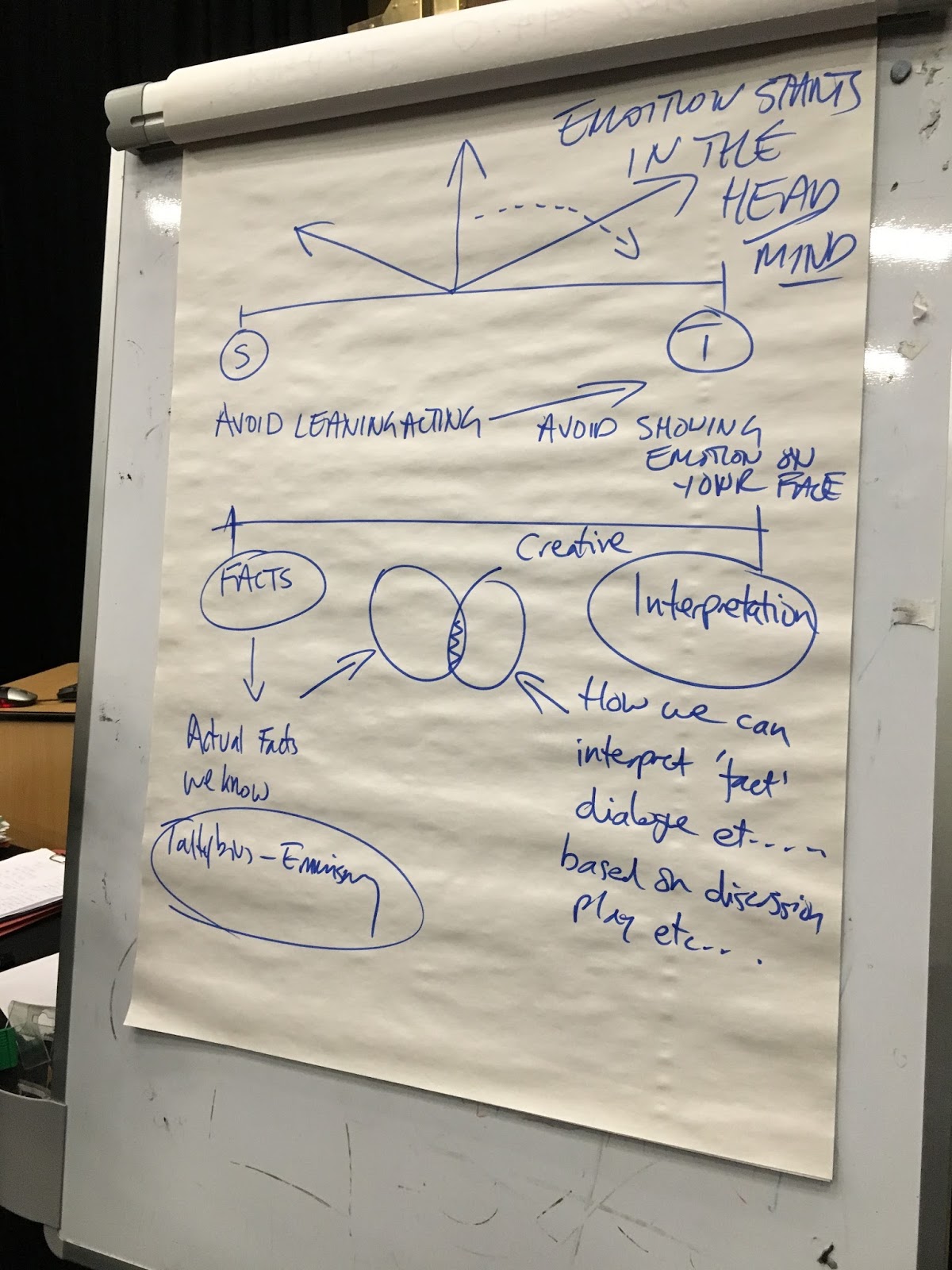
    To help us get used to our characters, and to build our roles, we worked on two acting books: Stanislavski's technique and Uta Hagen. I learnt that, as an actor, you have to express your feeling not to show them.
    At the beginning of every single lesson we were doing acting games, vocal and physical warm up, that woke us up, such as the tagging game and freeze frame and concentration exercises so we can be focused on what we have to do. I think that doing these games all the time train us to become good actors and help us develop our skills.

    Engaging with an audience

    The level 3 year 2 class came to see our rehearsals and they gave us a feedback. Mine and Sara's was really good, they said that we only need to practise our pronunciation. Rob also gave us a feedback, after every single rehearsing day, he said that it was genuinely good and that we should try to use the space that we have, to be aware  that the audience has to see my facial expression, to face the audience and not let my hair cover my face, he said that we were listening and reacting to each other, to turn the melodramatic theatre into our thing, to be in the skin of the characters. He also tried to help all of us by writing some advice when we were rehearsing and talking about this at the end of the lesson when he was giving us the feedbacks.


    Working at Medea

    At the beginning of every each lesson we were doing acting games to help us get ready for the rehearsals, every single lesson had different games, that helped us improve our acting skills.
    In our process, firstly,  we gave our lines, we staged the piece together, everyone came up with ideas. I've been the main character, Medea, but I haven't got any lines, instead of that, I had to use my emotions to express the anger and frustration that Medea felt at that point of the piece. We practised together and after we learned our lines and what we have to do, we started to work together as an ensemble. We decided to place Medea in the centre of the supporting characters for the audience to see that the tension was directed to her. The staging of our group was placed in a semi-circle shape around Medea to allow the audience to see all of the characters, this helped them see details, expressions and body language. Each line given by each person was delivered with a specific action.
    We also had to do some written work at the end of every each lesson, Sharon gave us log books and we wrote there everything that we were doing during the lesson.
    We received feedbacks from our partners and this helped us improving ourselves during the performance.
    What worked was that we were flexible, we had to change lines every time someone new came into our group. Our vocal projection was good, we created the tension that we needed. During rehearsals, we improved the staging by adding more movement.
    What could have been better is that we could have been more creative with the movements, we should have been more organised, we should listen to others opinions/suggestions, we should be in class in time because our team depends on us.
    This work prepares me to be a performer. It will help me when I'll have to work in an ensemble and it helps me get used to the work on a stage. Everything that I learnt during this process will help me in my future career as an actor.

    Friday, November 4, 2016

    UNIT 3 Introduction to Professional Practice

    1.

    Task 1 - We discussed the amount of the roles in the creative industry.
    Task 2 - We looked at if we were a producer theater

    company what job roles would be involved, then we discussed the potential issues that could get in the way from doing these roles, such as money.

    Skills actors need : communication, good vocal projection, strong voice, strong character, flexible, patient, determined, passionate, sense of awareness and timing, punctuality, improvisation skills, open minded
    What you have to do to become an actress:
    1. Study and learn how to use the acting techniques in college
    2.Do your blog, the universities/drama schools are interested in what you were learning in college
    3. NEVER be late, your class is your team,  if one member of the team is missing the others have difficulties
    4. Go to Drama school after you finish college
    5. Work hard and if you don't receive a role in a movie, you can make your own movie

    2. Film Director


    First of all you have to finish your Drama course in college then you have to go to an university which has the directing course, it equips you with the artistic and technical skills suitable for work or for further training in theatre, film, television and radio. Working closely with BA Acting, the course gives you a deep understanding of the acting process and a common language with performers. In the latter stages of the course you will experiment and express your voice in an increasingly challenging and diverse set of contexts across different media and gain valuable experience from professional placements. I will work both collaboratively and independently. Working alongside actors as part of an ensemble I will learn the importance of my creative contribution to the collective endeavour. I will engage in a range of collaborations with acting, writing and design students. In order to enter this course you have to accomplish the entry requirements which are :

    An applicant will be considered for admission who has already achieved an educational level equivalent to passes in two subjects at GCE Advanced Level, supported by passes in three other subjects at GCSE Grade C or above.
    This educational level may be demonstrated by:
    • possession of the qualifications named above;
    • possession of equivalent qualifications;
    • prior experiential learning, the outcome of which can be demonstrated to be equivalent to the formal qualifications otherwise required
    • a combination of formal qualifications and experiential learning which taken together can be demonstrated to be equivalent to the formal qualifications otherwise required.
    For candidates whose first language is not English a certificate attesting to achievement of IELTS 7.5 or equivalent is required.

    This course requires an interview

    Entry to MA Directing is highly competitive. Selection to the course is determined by the quality of the application: this is indicated primarily in the quality of your interview and practical work.
    • Foundation Diploma in Performance (Level 3 or 4)
    • A pass in 1 GCE A level
    • Passes at GCSE level in 3 other subjects (grade C or above)
    OR
    • Passes in 2 GCE A Levels (80 UCAS tariff points normally including one single award)
    • Passes at GCSE level in 3 other subjects (grade C or above)
    This educational level may be demonstrated by possession of equivalent qualifications; e.g. International Baccalaureat or High School Diploma.
    Applicants who do not meet these course entry requirements may still be considered if the course team judges the application demonstrates additional strengths and alternative evidence. This might be demonstrated by, for example: related academic or work experience; the quality of the personal statement; a strong academic or other professional reference; or a combination of these factors.

    English language requirements

    All classes are conducted in English. If English is not your first language you will be asked to provide evidence of your English language ability in order to apply for a visa, enrol, and start your course. The standard English language requirement for entry is IELTS 7.5 with a minimum of 6.5 in any one paper, or equivalent. For further information visit the English Language requirements page.
    Student Selection Process 
    1: all applicants must submit an application form including a CV and personal statement;
    2: on the strength of their CV and personal statement applicants will be shortlisted for interview.
    3: Some applicants will then be recalled for a second interview and a practical directing exercise with student actors. They may also be asked to submit a portfolio of their work. 
    4: You will be offered a place on the basis of how well you meet the selection criteria.
    Criteria for Selection 
    Your Application Form should reveal:
    • Your keen interest in theatre and/or film from CV and personal statement
    • Your understanding of the role of the theatre and/or film director
    • Your grasp of the training opportunities as outlined in the Drama Centre Course Book
     Your First Interview should reveal:
    • Your ability to respond to a particular classical text (set in advance)
    • Your ability to present yourself with confidence
    • Your ability to express your ideas clearly
    • Your engagement with the role of the director
    • Your enthusiasm for the course
    • Some knowledge of the world of theatre and/or screen
    • Your  understanding of the role of the theatre director
    • How well you grasp the training opportunities as outlined in the Drama Centre Course Book
    • Your future ambition
     Your Second Interview/Workhop should reveal
    • Your ability to respond to a particular directing task ( a contemporary, naturalistic  text set in advance)
    • Your ability to engage with actors
    • Your ability to analyse and interpret a piece of dramatic text
    • Your visual imagination
     Interview and directing advice
    • At both interviews you will be interviewed by not less than two people and a maximum of four.
    • You will be assessed on how well you have performed in the tasks set.
    The interviews, will last 20-30 minutes, You should arrive in good time for your interview and should be free within about an hour of your allocated time. Refreshments can be found in the canteen or within walking distance at a range of shops, takeaways and cafes.
    After you finish the university you need to find a job as a director.

    (Dramauk, 2017, www.dramauk.co.uk)